
COMPANY NEWS | JULY 14-16, 2026
ChainArgos at INTERPOL Project CHAIN Asia-Pacific Asset Recovery Workshop
ChainArgos General Counsel Patrick Tan delivered Session 3, Next-Generation Tools for Cryptocurrency Crime, covering control and seizability, freezing versus seizing, and what blockchain evidence must survive in court.
Introduction
Singapore, SINGAPORE – ChainArgos General Counsel Patrick Tan presented at the INTERPOL Project CHAIN Asia-Pacific Regional Workshop on Asset Recovery, held from 14–16 July 2026 and organized by the INTERPOL Financial Crime and Anti-Corruption Centre (IFCACC).
Patrick delivered Session 3, Next-Generation Tools for Cryptocurrency Crime, on the morning of the second day. Presented under the title From Chain to Court: Seizing Crypto Assets, the session ran for approximately one hour and was built around a single proposition: for law enforcement in the Asia-Pacific, the difficulty in crypto-asset recovery has moved. It is no longer principally a question of finding the assets. It is a question of reaching them in time, understanding who actually controls them, and proving the case afterwards to a standard that survives a courtroom.
The workshop convened officials from across five Asia-Pacific jurisdictions, drawn from INTERPOL National Central Bureaux, asset recovery units, anti-money laundering units, prosecutors’ offices, Financial Intelligence Units, customs and tax authorities, and virtual asset service provider (VASP) regulatory authorities. That mix — investigators, prosecutors, and supervisors in the same room — shaped the session, because the three groups encounter the same asset at three different moments, and each needs something different from it.
Seizure Is No Longer the Hard Part
The session opened by dismantling an assumption that still shapes a great deal of asset recovery practice: that crypto-assets are inherently harder to seize than conventional property.
For a significant and growing share of the assets that actually appear in Asia-Pacific casework — centrally issued stablecoins above all — the opposite is closer to the truth. A dollar in a bank account in a foreign jurisdiction requires mutual legal assistance, a cooperative counterpart institution, and time measured in months. A centrally issued stablecoin can be frozen by its issuer on request, from anywhere, in minutes. There is no branch to visit, no correspondent chain to traverse, and no need for the asset to be physically anywhere in particular.
The scale of this is not hypothetical. Participants were walked through the numbers: 7,268 addresses blacklisted by Tether, roughly half of all frozen USDT sitting on TRON, and roughly USD 4.2 billion of USDT frozen in total, USD 3.5 billion of it since 2023. Issuer-level freezing is now an established, routine instrument of asset recovery — not an experimental one.
The practical consequence for investigators is that the operative question is not can this be seized but who controls it, and what will make them act.
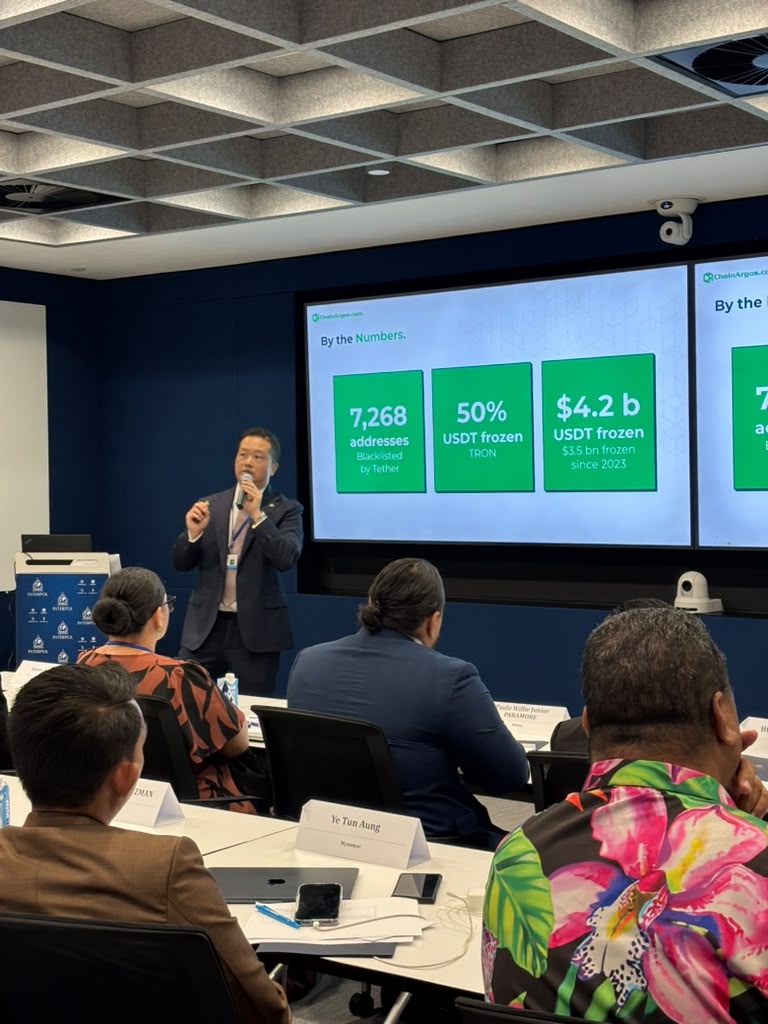
ChainArgos General Counsel Patrick Tan on seizing frozen USDT – INTERPOL Project CHAIN
Freezing Is Not Seizing
The distinction the session pressed hardest on was between freezing and seizing, because conflating the two is where agencies lose assets.
Freezing only affects a crypto-asset or stablecoin controlled by a centralized issuer. It is an act performed by a private company at the edge of its own ledger. It renders the tokens unusable; it does not move them, and it does not resolve who owns them. Assets held in self-custody — bitcoin, ether, and anything else without an issuer able to intervene — cannot be frozen by anyone, at any time, on any request.
Seizure and, ultimately, forfeiture are different animals: judicial, contested, slow, and the only mechanism that actually transfers title. An agency that treats a successful freeze as the end of the matter has not recovered anything. An agency that waits for forfeiture-grade evidence before seeking a freeze will usually find there is nothing left to freeze.
Sequencing these correctly — moving quickly to preserve, then building deliberately to prove — was presented as the single highest-leverage change most asset recovery units can make.
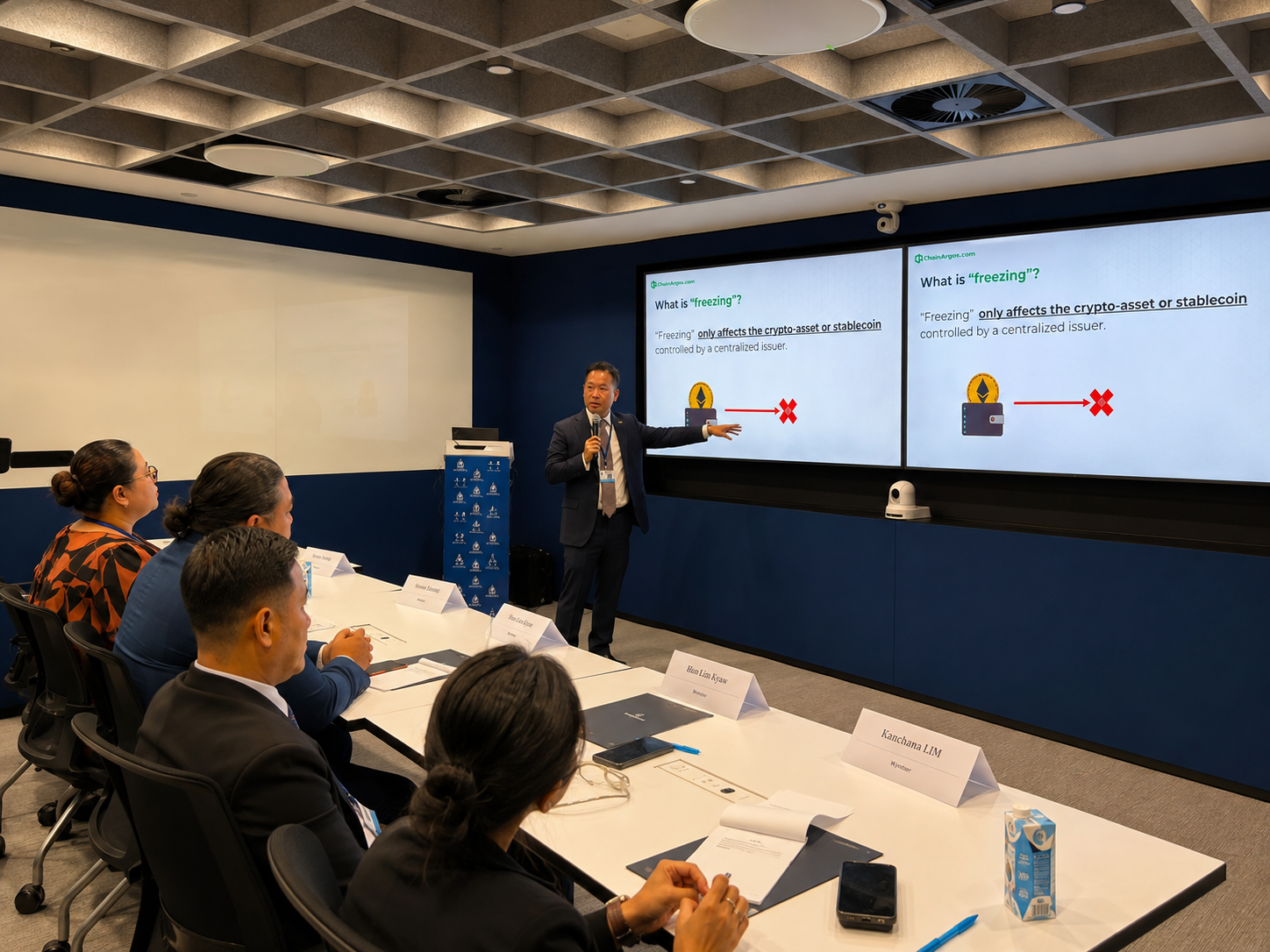
ChainArgos General Counsel Patrick Tan on freezing and centralized stablecoin issuers – INTERPOL Project CHAIN
The Seizure Process Is a Race
If control is the first question and characterization the second, timing is the third — and it constrains both.
Crypto-assets move at the speed of a block. Cross-chain bridges, decentralized exchanges, instant swap services, and mixers such as Tornado Cash, CoinJoin implementations, and their successors allow an asset to change form and jurisdiction repeatedly while a request for assistance is still being drafted. The window between detection and immobilization is frequently measured in hours; the procedural apparatus most agencies have available was not designed for that timescale.
The session worked through the mechanics of that process in practice — who to contact, what to ask for, what evidence an issuer or exchange will actually act on, and what a domestic court will require afterwards to convert a freeze into a forfeiture.
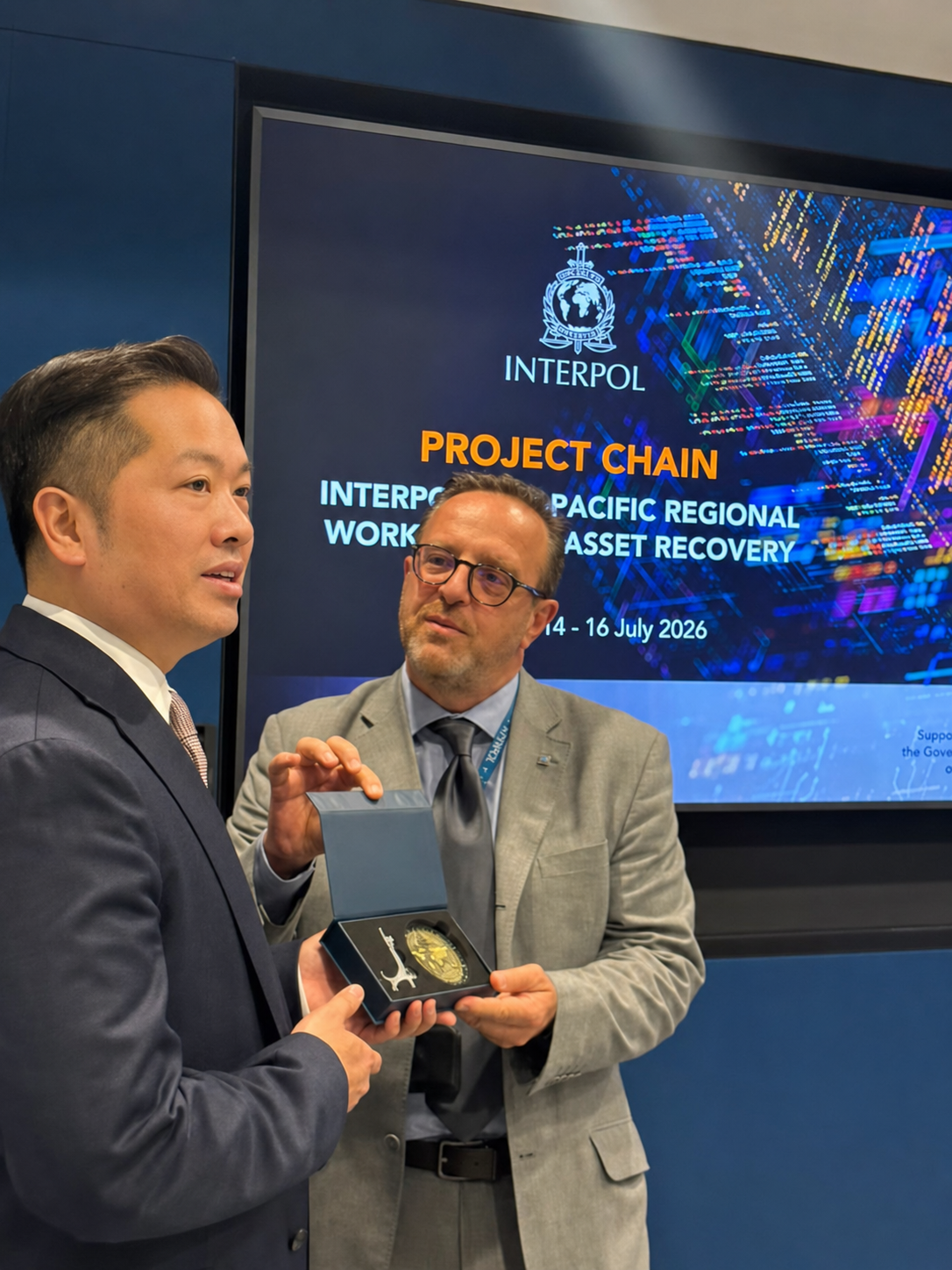
ChainArgos General Counsel Patrick Tan receives a token of appreciation from Claudio Marinelli, Operations Coordinator - INTERPOL's Financial Crime and Anti-Corruption Center.
From Chain to Court: What Survives Cross-Examination
The final part of the session moved from recovery to proof — the point at which blockchain intelligence stops being an investigative aid and becomes evidence.
Patrick drew a distinction that ran through the remainder of the hour: between financial data that is objectively provable and analytical output that is merely asserted. Transaction hashes, amounts, timestamps, and the movement of value between addresses are facts any party can independently confirm. Address clustering, entity attribution, and risk scoring are interpretations, dependent on assumptions that are frequently undisclosed. A case that does not keep the two separate invites a challenge it cannot answer.
ChainArgos’s empirical research demonstrating false positive rates of between 7% and 83% for widely used clustering methodologies was presented not as a criticism of any vendor, but as a working caution for prosecutors: an attribution generated by a proprietary methodology, produced as a conclusion rather than as a tested hypothesis, is a liability in an adversarial proceeding.
ChainArgos’s work in this area — including our amicus brief in United States v. Sterlingov — proceeds from the position that blockchain evidence should be reproducible by an opposing expert working from the same public data. Participants were encouraged to ask of any analytical output, before it reaches a filing, a deliberately unglamorous question: could someone else, given the same chain data and no access to our tooling, arrive at this conclusion?
Returning to INTERPOL
Project CHAIN marks ChainArgos’s return to INTERPOL following the blockchain intelligence training we delivered to INTERPOL’s New Technologies Forum in October 2024, and the themes have shifted in a way worth noting.
In 2024, much of the work was foundational: establishing what blockchain tracing can and cannot show, and why a single-source-of-truth model maps poorly onto a system in which creating a new address is trivial and costless. Two years on, that argument no longer needs making. The questions from the room in 2026 were operational and jurisdictional — how to reach an issuer, what a domestic court will accept, how to preserve value while a case is built, and what to do when an asset has moved three chains and two jurisdictions before the paperwork clears.
That shift, from whether this evidence is sound to how do we act on it in time, is a reasonable proxy for how far law enforcement capability in this area has matured.
Looking Ahead
Asset recovery is where blockchain intelligence is tested most severely. An investigative theory that is merely plausible is sufficient to open a line of enquiry; it is not sufficient to take property from someone. The gap between those two standards is precisely where this discipline still has work to do.
ChainArgos is proud to support the work of INTERPOL and of the law enforcement, prosecutorial, and regulatory agencies across the Asia-Pacific that took part in Project CHAIN. Our thanks to the INTERPOL Financial Crime and Anti-Corruption Centre for the invitation and for the care taken in convening the programme, and to the participants for questions that were consistently more pointed than the ones we had prepared for.
Crypto-asset recovery is becoming a routine part of financial crime enforcement in the region. Making it a defensible routine is the work that remains.