

Introduction
Every so often a proposal surfaces in Washington to change how the United States taxes the people who keep blockchain networks running. The latest round came in June 2026, when industry advocates told the House Ways and Means Committee that the rewards these participants earn should be treated as newly created property and taxed only when sold, rather than when received. The argument has an intuitive appeal. A farmer is not taxed on a crop while it is still in the field, and a manufacturer is not taxed on goods sitting in a warehouse. Why, the argument goes, should someone who helps run a network be taxed the moment the network pays them?
This opinion piece attempts to explain why the comparison does not hold. Our conclusion is that the existing rule, under which these rewards are income when received, is the right one, and that most of the proposed alternatives would open a gap in the tax base far wider than the activity they are meant to accommodate. To make that case we first need to explain, for readers who do not follow this industry closely, what these rewards actually are.
Setting The Scene
A blockchain is a shared ledger of transactions maintained not by a single institution but by many independent computers running the same software. Somebody has to gather new transactions into a batch, check them, and add that batch to the ledger. Each batch is called a block, and the participants who add blocks are paid for doing so. That payment is the block reward.
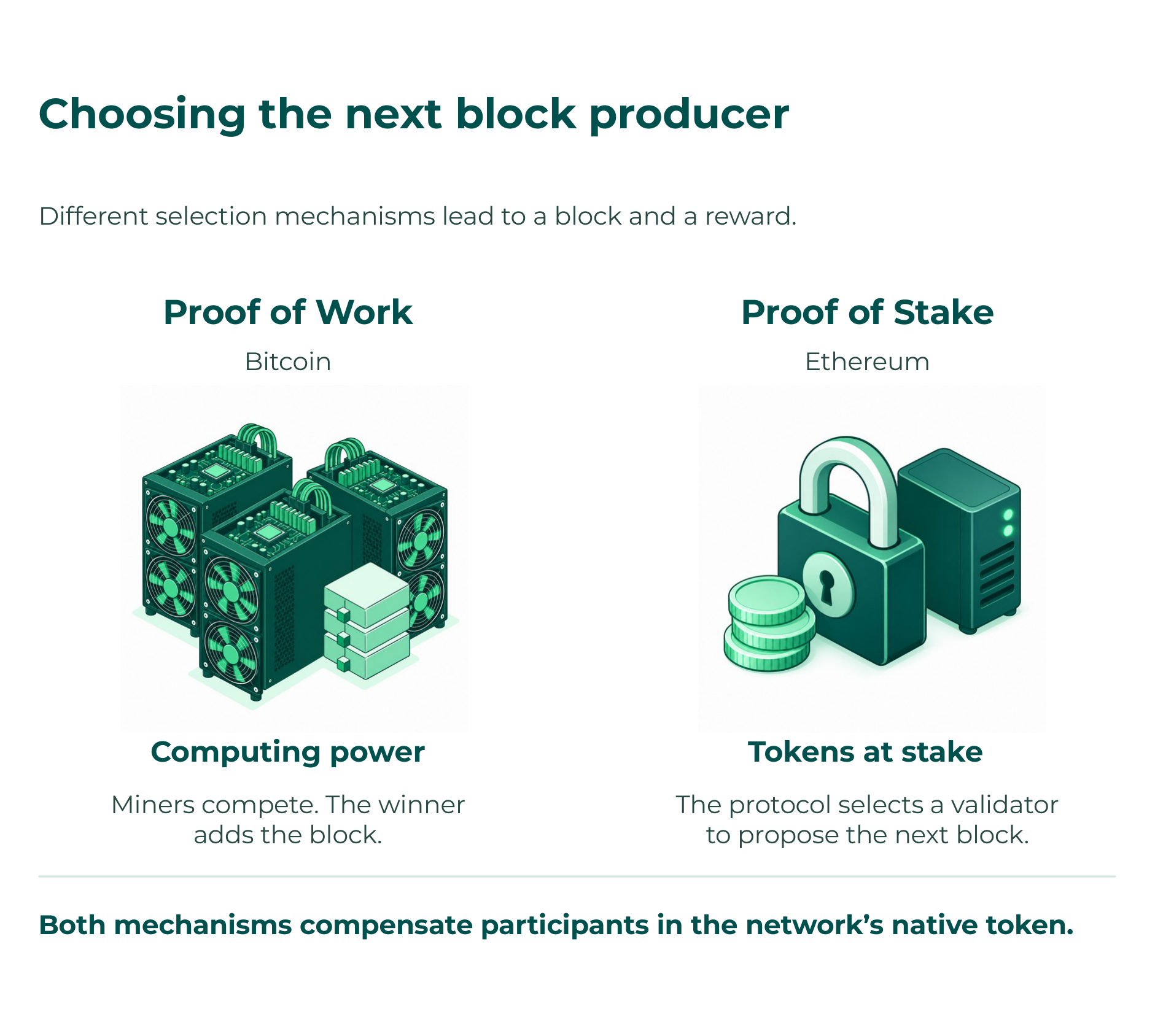
Networks select who gets to add the next block in one of two main ways. In Proof of Work (PoW) blockchains, the model used by the Bitcoin blockchain, participants known as miners compete by expending computing power, and the winner adds the block. Under Proof of Stake (PoS) blockchains, the model used by Ethereum and most newer blockchain networks, participants known as validators lock up a quantity of the blockchain network’s own tokens as collateral, and the software selects among them to add each block. In both models the reward is paid in the blockchain network’s native token, and in both models it has two components. The first is the fees paid by the users whose transactions were included in the block. The second is a subsidy, an additional amount that the blockchain network’s rules direct to the block producer.
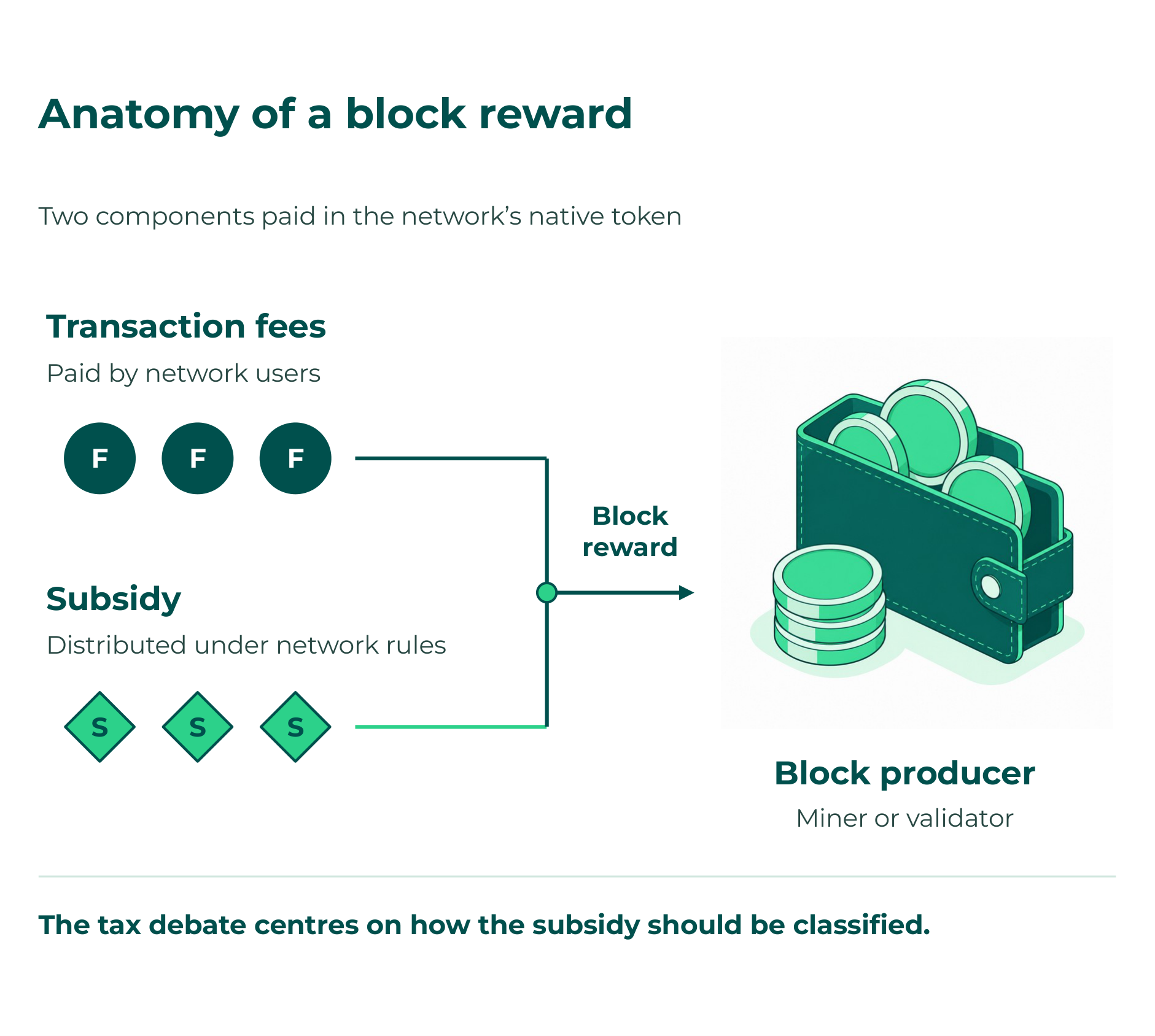
The tax question turns on that second component.
Nobody seriously disputes that the fee component is income. The debate is over whether the subsidy is better understood as a payment for services, taxable when received, or as new property created by the recipient’s own effort, taxable only when sold. The Internal Revenue Service has taken the first view.
Building on its earlier guidance on mining, Revenue Ruling 2023-14 confirms that a taxpayer who receives rewards for validating transactions on a PoS blockchain network has income equal to their fair market value at the time the taxpayer gains control over them. Industry advocates have taken the second view, most prominently in Jarrett v. United States, a refund suit brought by a Tezos validator, and in a series of written statements and reports arguing for a legislative exemption.
The disagreement cannot be settled by analogy. It has to be settled by looking at what the software actually does when a block reward is paid, and that is what the rest of this note sets out to do.
The Short Answer
Our view is that block rewards should be taxed as income when received. The default United States position is that income is taxed on receipt, and the only question is whether an exception is justified in the case of blockchain validators. The most common basis advanced for an exception is that block rewards are “newly issued”1 or “new property created by participants”2 and therefore more akin to freshly grown agricultural produce than to recycled financial instruments. In our view this argument does not survive contact with how these blockchain networks actually work.
The vast majority of block reward distribution schemes explicitly recycle existing property. Most other schemes are economically equivalent to redistribution schemes, with a layer of technology that makes this harder to see. There is a small number of cases where block rewards do not consist entirely of redistributed tokens that already existed. These cases are neither common enough nor sufficiently different to justify making the rules around block reward taxation more complex in order to accommodate them.
Throughout this discussion it is worth remembering that simple rules are essential. These are complex software systems, and any complexity in the rules will be found and potentially exploited. The rules need to be simple and comprehensive if they are to raise any revenue at all. They also need to be observable. Every mechanism discussed below leaves a complete record on a public ledger, down to individual fee payments, burns, and reward distributions. The data needed to apply a simple rule already exists. What matters is that the rule is simple enough for the data to answer it.
Most Block Rewards Are Explicitly Not New Property
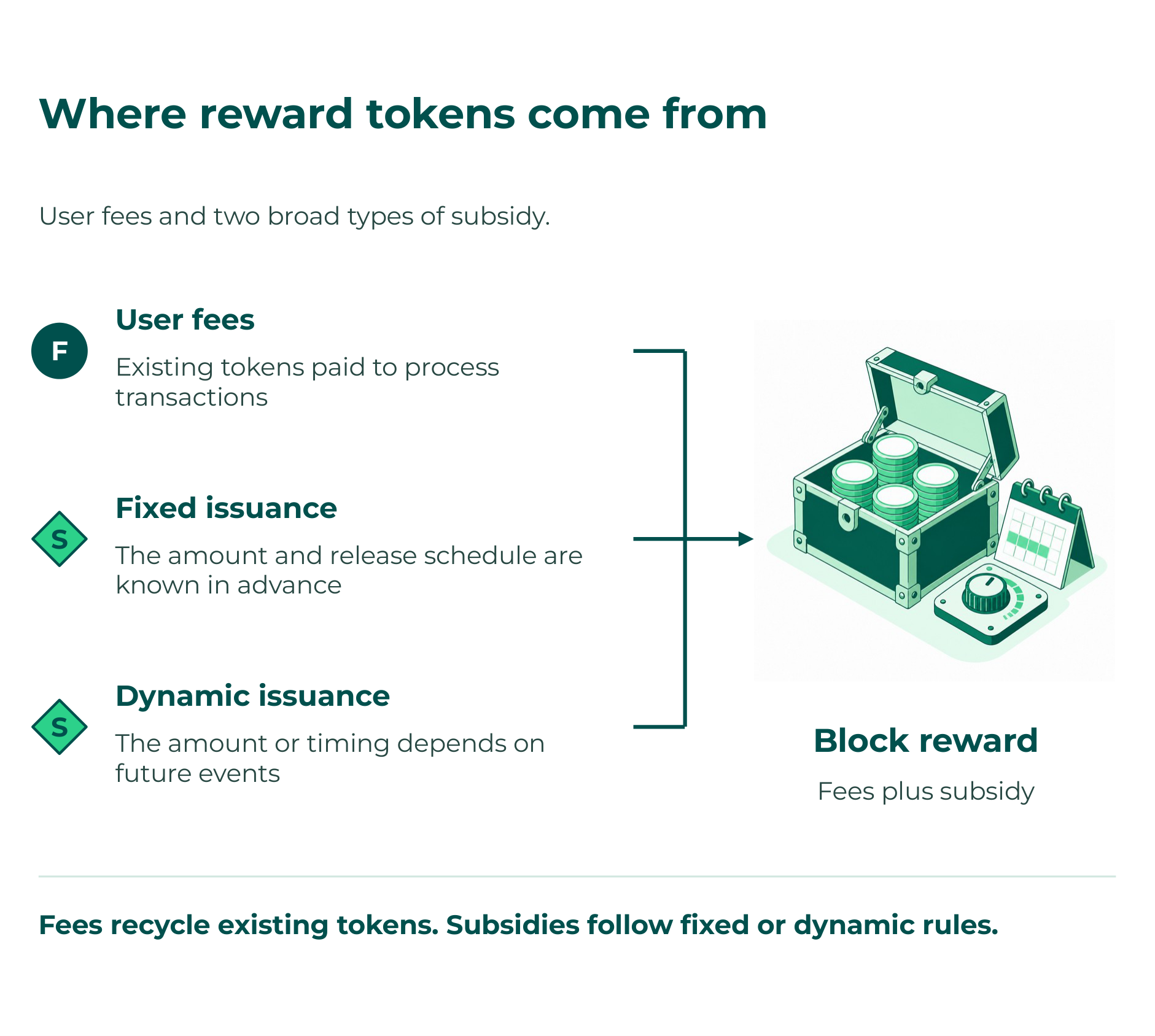
All block validation schemes can source tokens for block rewards from two places, namely fees paid by participants and anywhere else. As Omri Marian has observed3, the fee component of the reward is clearly taxable upon receipt, and we too are unaware of any contrary argument. The “anywhere else” further breaks down into two categories. The first is fixed issuance, known in advance, from a source that is also known in advance. The second is any kind of dynamic scheme. Conceptually, think of the former as something like a central treasury account funded with reward subsidy tokens before the whole process begins, and the latter as any mechanism where the number and release schedule of future tokens depends on future events. If this sounds a little vague, the examples below will make it concrete.
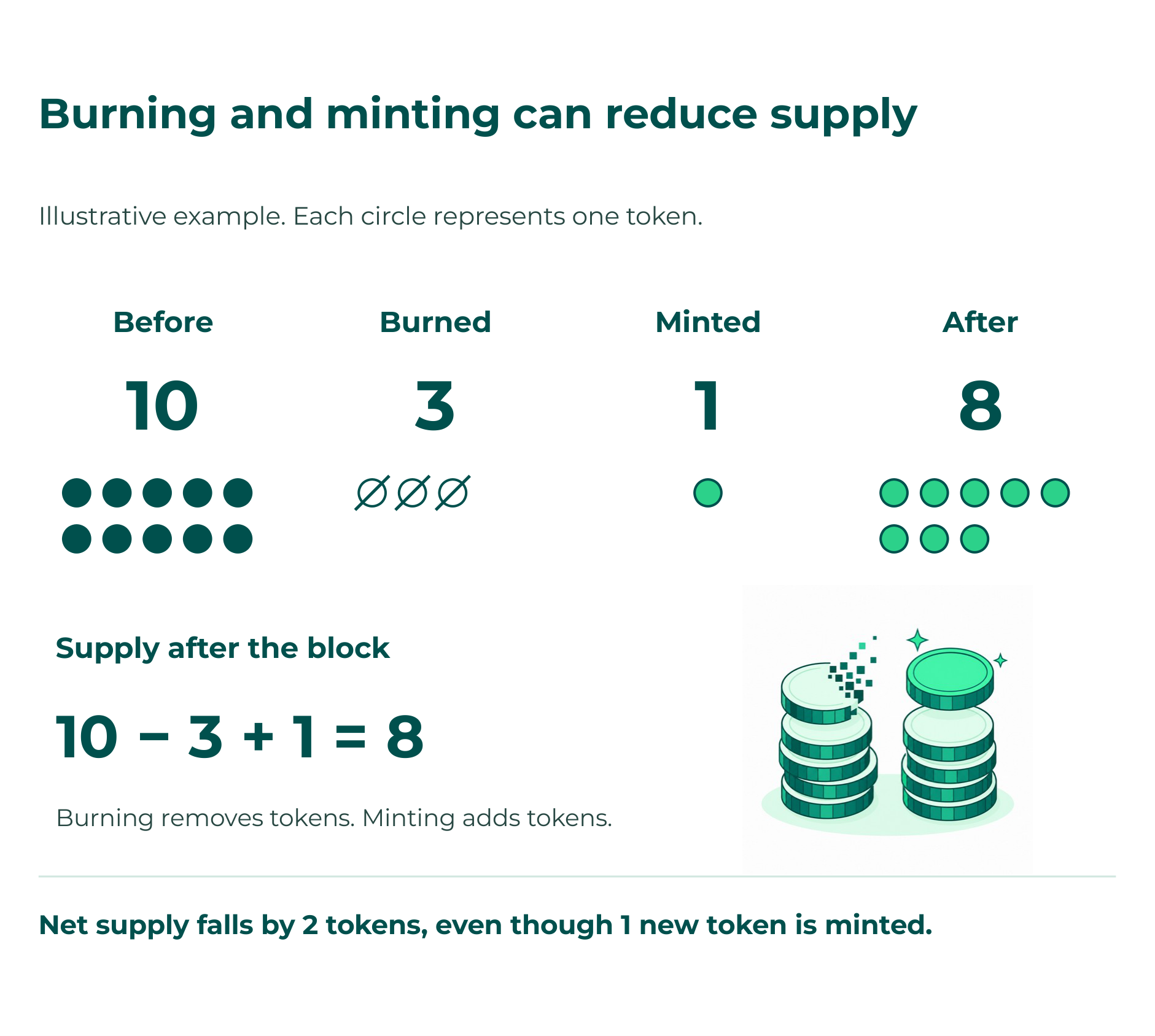
Nearly all PoS schemes burn a fraction of the fees participants pay, and to burn a token is to remove it permanently from circulation. Nearly all PoS schemes aim to reduce the overall supply of tokens over time, even where there is a substantial reward subsidy component. Such networks are known as deflationary. Other PoS blockchains recirculate a fixed total supply of tokens. PoW blockchains are addressed below.
For networks where the total supply of tokens is constant or decreasing it is immediately obvious that no new property is created. It does not matter whether a treasury account is releasing a subsidy or a software process is “producing” tokens if the gross supply is falling. Mechanically the software may burn certain tokens and then mint, meaning create a smaller number of new ones. So long as the gross supply decreases, no new property is created. Nor does it matter whether network participants are paid in proportion to the amount of work they do or on some other basis. If they are paid with tokens that already exist, the rewards are a redistribution scheme.
The same applies to tokens where a central treasury pays incentives or any other form of compensation to validators. So long as that treasury funds payments from an existing balance of tokens, no new property is created. Nobody would suggest that receipts from a trust are exempt from tax because of the controls around the trust’s management. Stock splits are not taxable, but stock compensation certainly is. Block rewards are no different.
Bitcoin’s PoW Mining Is Equivalent To Recycling Existing Property
Bitcoin, famously, has a long term cap of 21 million tokens. With each block some amount of Bitcoin is distributed to the PoW miner that wins that block.
Mechanically, this is identical to a treasury account holding a premine of 21 million tokens before the genesis block and then paying an incentive in line with the Bitcoin blockchain’s token emissions schedule. A premine is an allocation of tokens created before a blockchain network goes live, and the genesis block is the first block in the blockchain. There is no economic difference between a balance of 21 million less circulating supply sitting inside an immutable smart contract, meaning a program that runs on the blockchain itself, and the way Bitcoin works today.
By convention the source of Bitcoin mining rewards is the “coinbase4” (not to be confused with the crypto-asset exchange of the same name) transaction, but we could just as well call it “treasury” or give it a name that looks like a Bitcoin blockchain address. The name changes nothing, so there is no reason for tax treatment to vary.
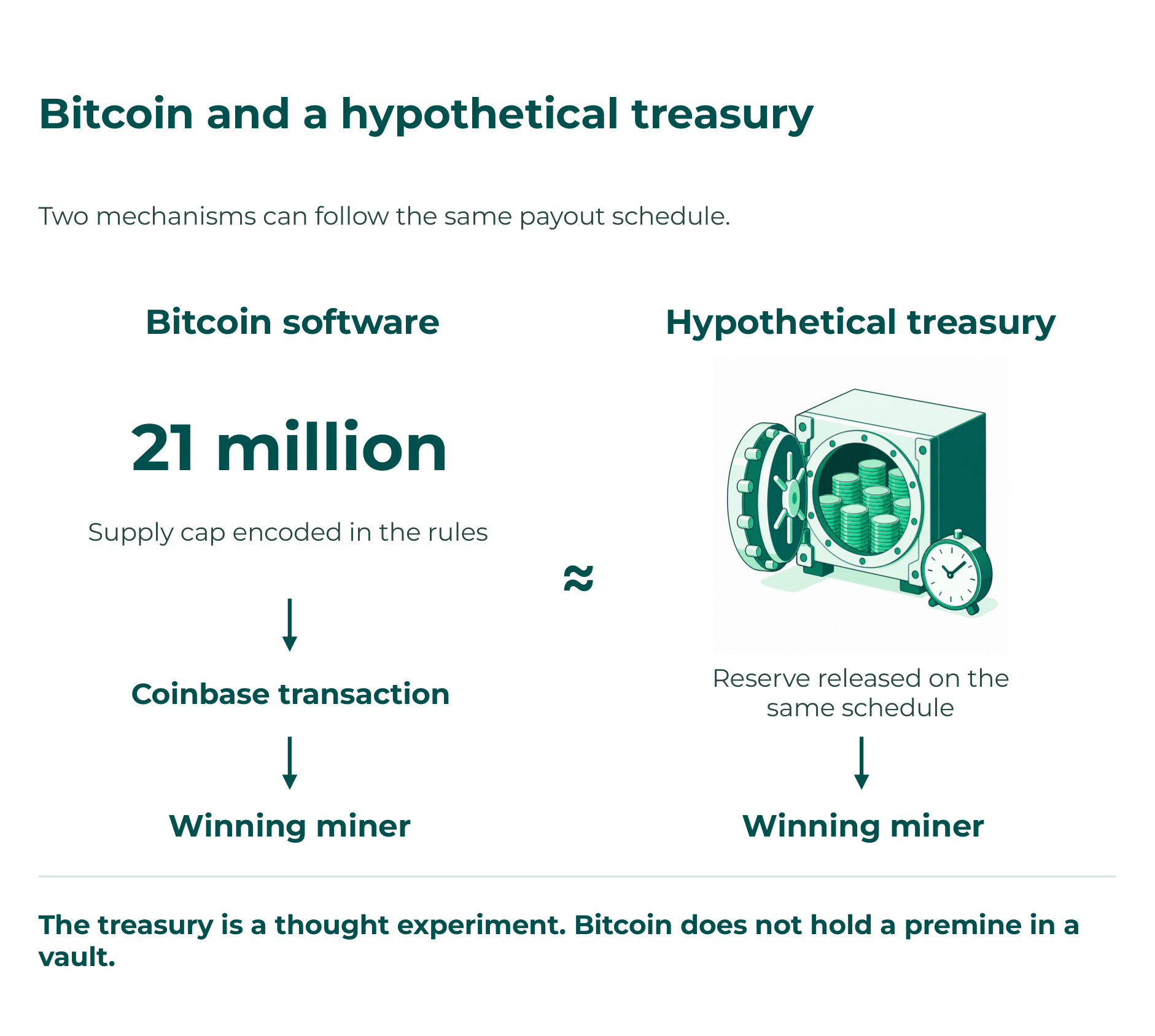
If the rules codify a difference in taxation between explicit balances in treasury accounts and token emissions schedules embedded in blockchain node software, we can be confident that that difference will be exploited. As a thought experiment, consider whether the argument changes when blockchain mining rewards are paid out of a smart contract rather than a hard coded blockchain address. The difference is a software engineering choice with no meaningful economic distinction.
A Small Number Of Corner Cases
There are some blockchains where token supply increases as a function of blockchain network utilization and block rewards are funded in part with new tokens. Even in these cases a portion of the rewards comes from recycled transaction fees. A token with uncapped supply, where supply growth is a function of network utilization, is not equivalent to incentive distributions out of a treasury balance.
There is a real difference here.
In Jarrett v. United States the issue of PoS staking that prompted much of this discussion concerned a blockchain network called Tezos. On the Tezos blockchain, block rewards are a mix of recycled fees and new tokens from an uncapped supply. Tezos is admittedly a complex scheme, and because it is not representative of PoS reward schemes in general, the goal should be rules that happen to give an acceptable answer for Tezos rather than rules tailored to Tezos’ unusual setup.
This presents essentially three choices.
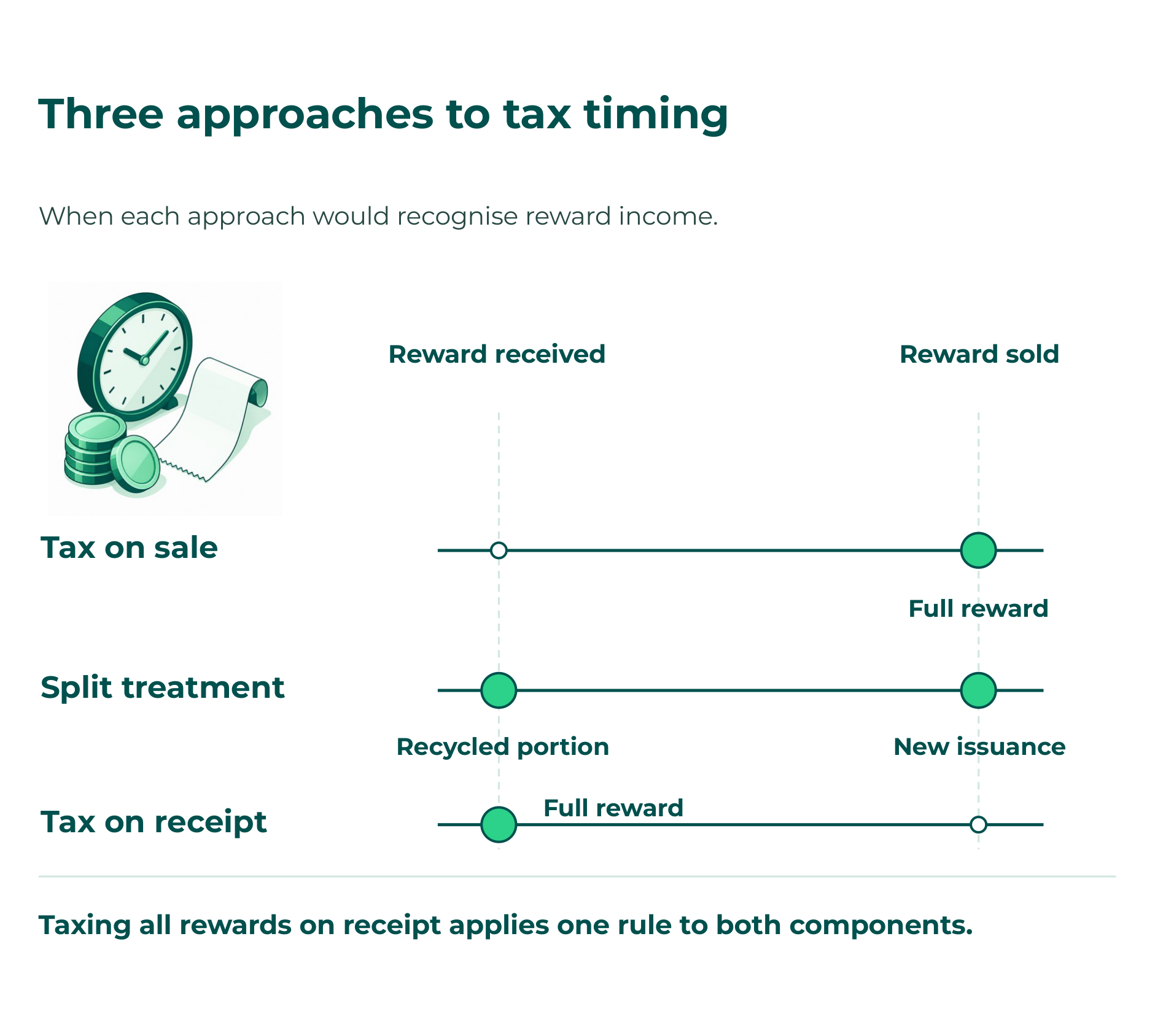
The first is to tax these rewards on disposition. The problem with this approach is that a blockchain network with near zero utilization and high fees would provide a simple vehicle for deferring tax on any transaction processed by computers. This is a loophole that could encompass much of the economy, and we think it goes some way toward answering one commentator’s observation that “it is difficult to identify a rational tax motivation for validators to argue against current taxation of block rewards”5. We address this in more detail below.
The second option is to split taxation between the recycled portion and the freshly created portion. This closes the obvious loophole but increases complexity and risks creating new ones. It is also entirely measurable. The split between fee revenue and new issuance in any given block is public blockchain data. The objection to this option is complexity of rules, not availability of evidence.
The third option is to tax all block rewards on receipt. This is by far the simplest approach and the one we argue makes the most sense.
Simple Rules Are Better
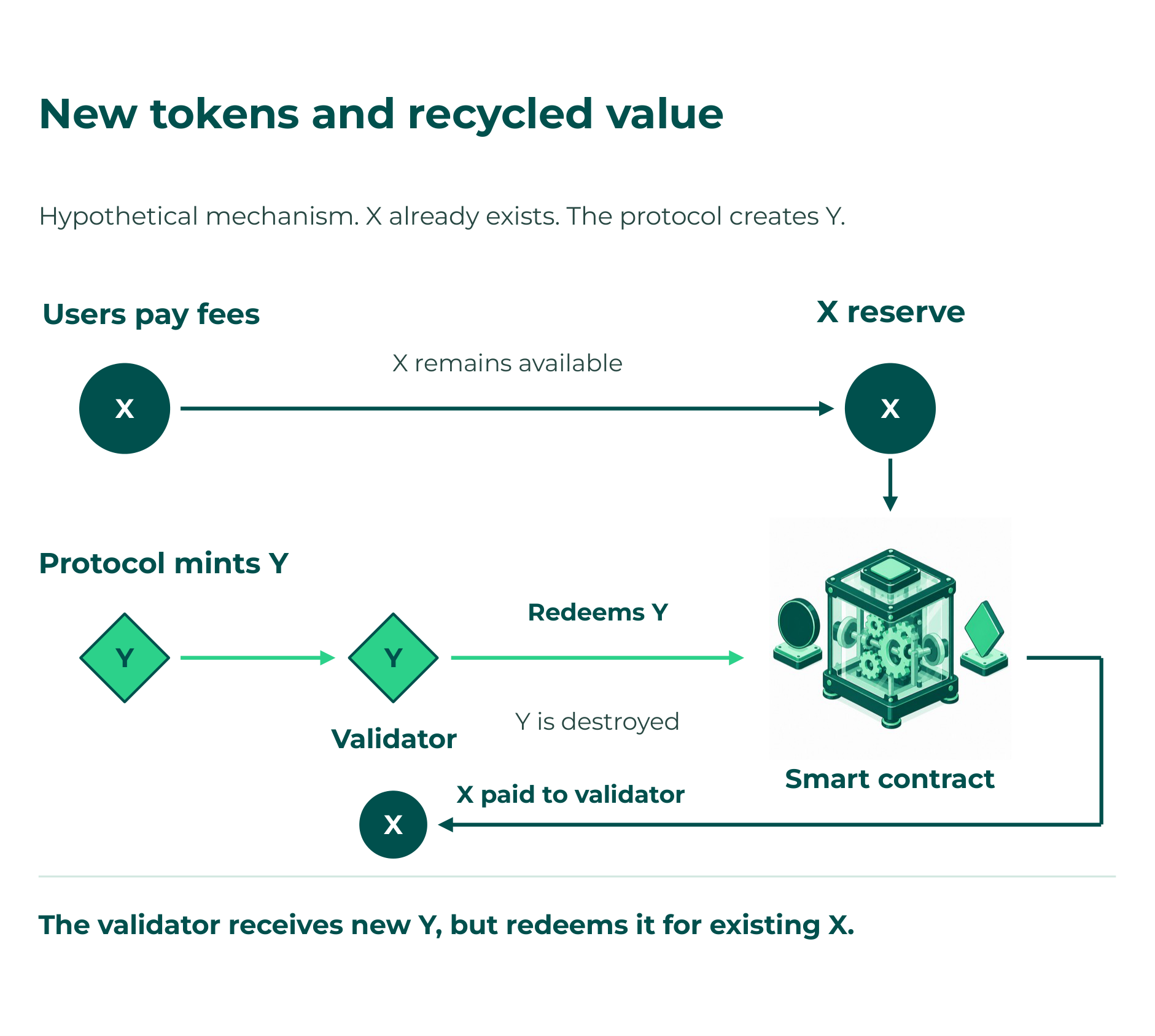
To show why we place so much weight on simplicity, we will give an example of how to exploit any loophole in the tax rules for block rewards that consist of freshly created property. Imagine a network with native token X in fixed supply. Validators are paid block rewards in token Y in proportion to the volume of blockchain transactions executed in a block. All fees paid in X are diverted, in each block, to a dedicated fee burn account. This account is linked to a smart contract that will redeem Y for X at a price linked to the ratio of transaction count to fees paid. All Y received are burned once redeemed for X.
Mechanically the block rewards consist entirely of freshly created Y. Economically the block rewards consist entirely of recycled X. This software code is trivial to write. Simple blanket rules are required because these differences of kind dissolve with simple software.
We will now sketch how existing, widely used products could be combined to take advantage of any special treatment of PoS block rewards. Nothing in this sketch is a criticism of the products themselves, each of which serves a legitimate purpose.
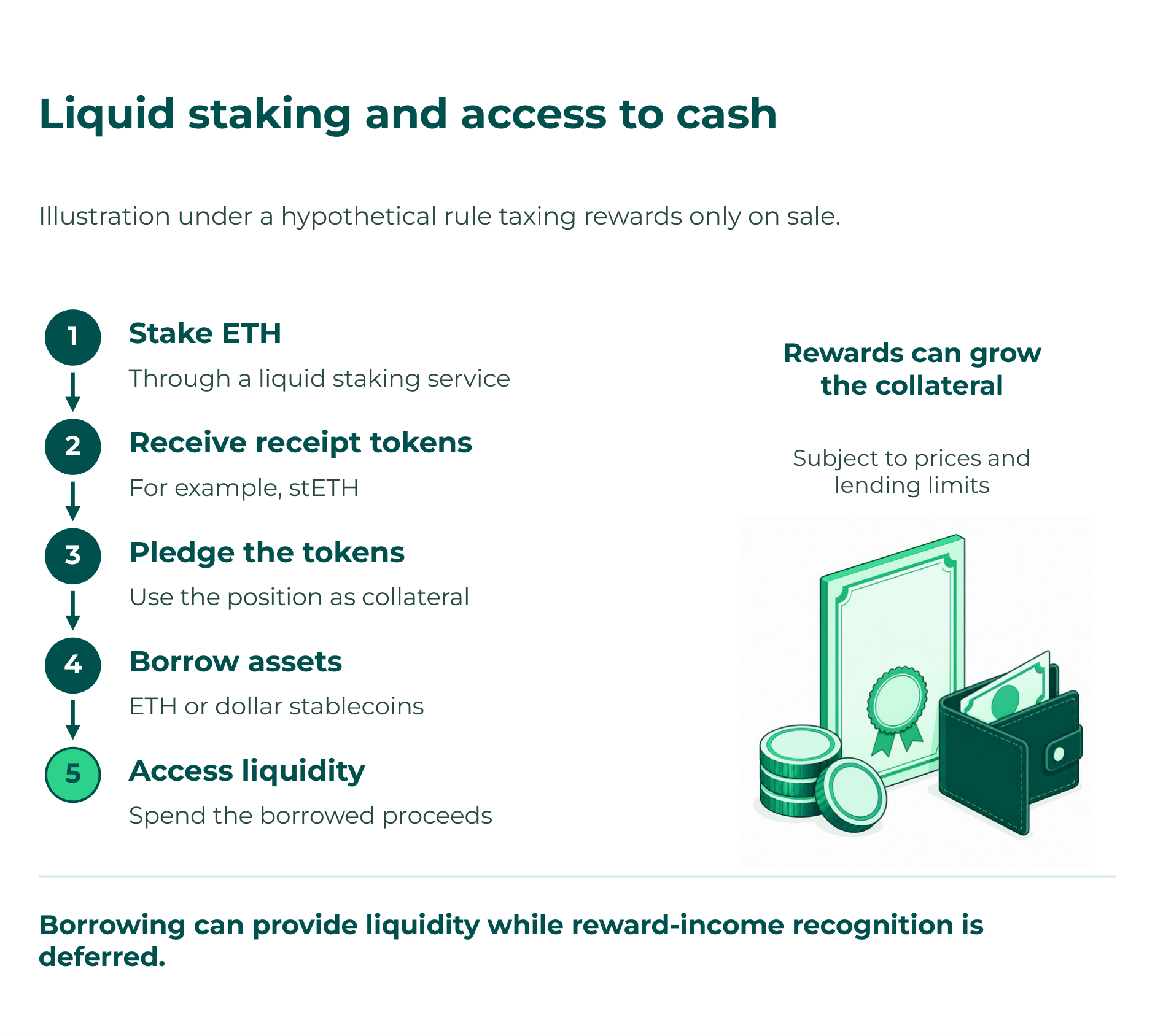
Ethereum is a large PoS blockchain network with a validation process that distributes billions of dollars in gross block rewards every year. To earn block rewards one must stake ETH tokens, which locks them up for a significant period as part of the blockchain’s security architecture. One common way to stake ETH is through a liquid staking service, an arrangement in which ETH tokens are staked on the user’s behalf and the user receives a freely tradeable receipt token, such as stETH6, that represents the staked position. The staked ETH earn rewards, and those rewards are passed through to receipt token holders periodically. The value, denominated in ETH, of any account holding such a receipt token therefore accretes over time.
Such an account can then pledge the accreting balance of receipt tokens to a lending protocol that will lend ever larger amounts of assets against it. Alternatively, the account could pledge block rewards as they arrive. A wide range of permissionless protocols accept these assets as collateral for non recourse loans denominated in ETH or in stablecoins pegged to the US dollar. Under a disposition based rule, a staker using these mechanisms could have access to dollars today while the underlying income is deferred for a very long time, or never recognized at all. Each step of this chain (pun intended) is visible on the ledger. Reward accrual, pledging of collateral, and loan drawdowns are all recorded as blockchain transactions, and each can be followed from origin to end use.
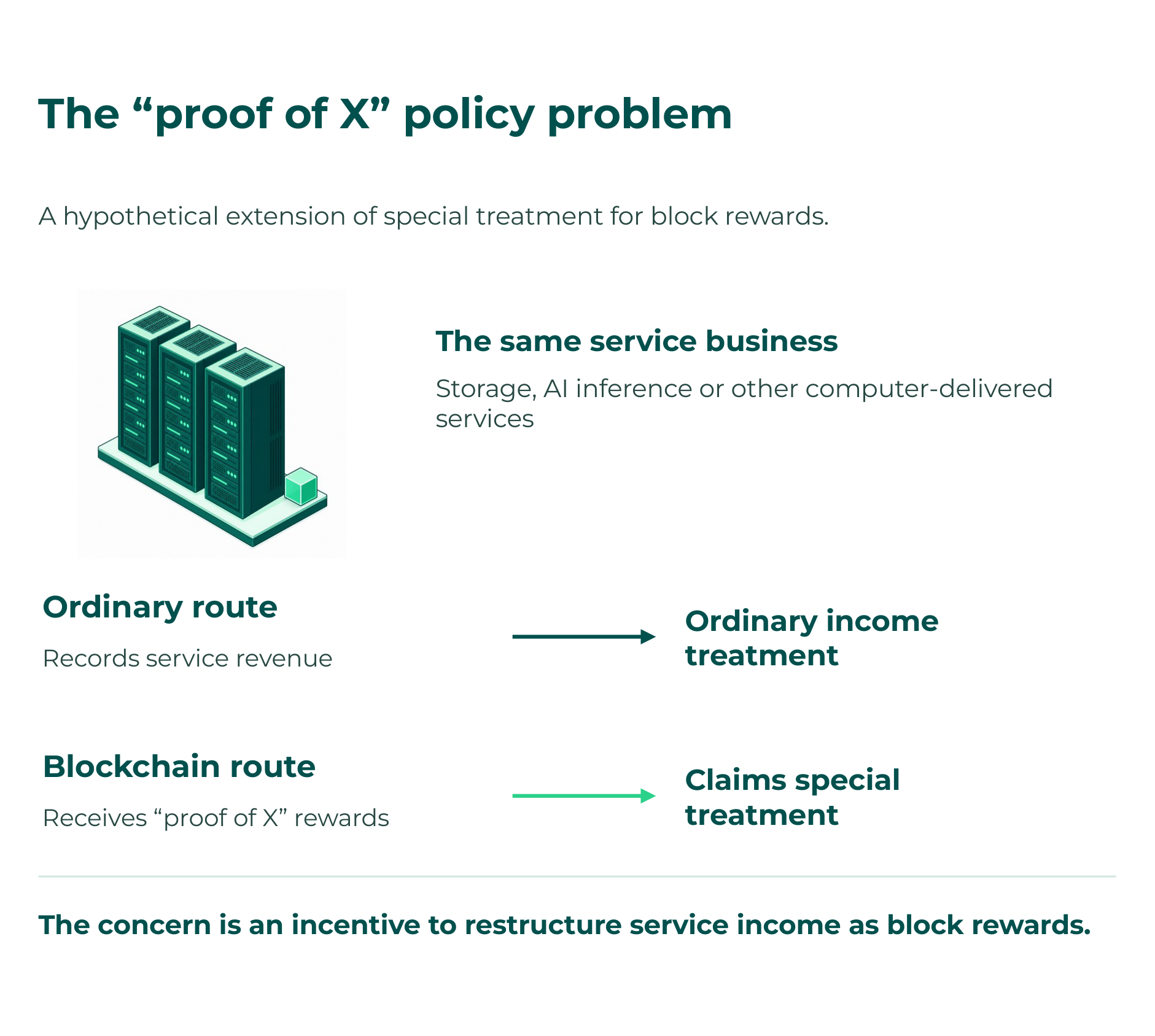
In the case of ETH and liquid staking products the underlying activity is at least blockchain validation. Now imagine a business providing a data center or similar capacity. Instead of simply validating blocks, the task performed by the blockchain might be storage, as with Filecoin, or the provision of AI inference, or something else entirely. All that is required is a “proof of X” where X involves doing whatever the business does.
Exempting rewards then becomes exempting the income of businesses that provide services through a “proof of X.” The tax code would reward the introduction of blockchains into business operations merely to claim an exemption. This makes no sense.
Whatever the intent of any particular advocate, the structural effect of a PoS exemption would be to remove taxation from the revenue of blockchain mediated businesses, and that is an incentive the market can be expected to respond to. Observers have noted for many years that there are myriad projects with a blockchain that do not really need one. Giving tax advantages to one form of database for recording revenues would be a powerful motivator to reorganize IT systems. It is a modern equivalent of the anecdote often attributed to Milton Friedman about creating jobs by giving workers spoons rather than shovels7.
In our view, efforts that present these questions as “challenging regulatory puzzles”8 miss the point. The malleability of software, its ability to operate complex and intricate systems from what looks like a simple base of elementary operations, is what makes these questions simple. Blunt rules are needed so that the flexibility which gives software its power cannot be used to evade them trivially.
Existing IRS guidance9 takes the reasonable position that block rewards are taxable on receipt because no existing provision of law or regulation exempts them. This is a statement of fact. There is no exemption in the law.
Industry participants are advocating for a special exemption. The argument is essentially that “new property created through one’s own labor or capital is not taxed when created” and that block rewards are new property. As discussed above, the predicate is false with respect to the vast majority of crypto-assets. And to the extent the predicate is sometimes true, the logic is still flawed, because it would provide a simple way to avoid essentially all taxation. Further examples along the lines of those above are easy to construct.
Dilution Is A Red Herring
Some have argued that PoS rewards are dilution and therefore more akin to stock splits than to transfers of wealth1011. The first thing to note is that dilution in the ordinary sense of company equity does not apply to these blockchain mechanisms. The concept of dilution is that a company is worth X with Y outstanding shares, and the naked issuance of more shares increases Y and therefore decreases the value per share. This is about the naked issuance of shares. Companies routinely issue shares to raise capital for projects the market likes, or to enter into mergers, and see their stock price rise. Issuance is not dilution. Dilution requires diluting the value per share or per token.
What causes stock prices to fall are surprise share issuances to cover losses, or to undertake projects or mergers the market does not like. Similarly, if a company systematically increases its share count by compensating employees in new stock, that can dilute value. Whether companies should pay in cash or stock, and whether they should buy back that stock on the open market to keep their share count roughly stable, are corporate finance questions we will not address here.
The key difference is that token issuance known in advance is not dilution. If everyone knows the issuance schedule, we can reasonably assume it is priced in. This is nothing like an announcement of a capital raise to fund a large factory or a merger. Further, many blockchains issue new tokens in proportion to the level of activity on the blockchain network. If issuance is linked to expanding activity, then dilution in the literal sense is not happening. One might argue that linking issuance to activity reduces a token’s propensity to appreciate, or not. Again, these are finance questions we will not address. If one buys into a blockchain network knowing that token issuance will increase if the blockchain network takes off, one cannot then act surprised when the token count expands alongside blockchain network activity.

What This Means for Regulators and Taxpayers
For legislators and tax authorities, the practical lesson is to be wary of any rule that depends on classifying a block reward as recycled or newly created. The classification can be changed by a software update, and the incentive to change it would be substantial.
A single rule that treats all block rewards as income on receipt is not only the current law but the only version that does not invite its own circumvention. For validators, miners, and the businesses that serve them, the lesson is that the record of what was received, and when, already exists and is public. Working from that record, rather than against it, is the surest way to get the position right.
The policy question is narrow. Block rewards are income, they are received at an identifiable moment, and the amount received is recorded permanently and publicly. Tax administration in most of the economy depends on records that taxpayers keep and authorities must trust. Here the record keeps itself. The task for authorities, and for taxpayers who want to get this right, is to read that record accurately and at scale.
Footnotes
- https://waysandmeans.house.gov/wp-content/uploads/2026/06/Written-Statement-Jason-Somensatto-Ways-and-Means-9-June-2026-2.pdf ↩
- https://coincenter.org/trumps-big-crypto-report-is-coming-it-should-address-block-rewards-and-privacy/ ↩
- Law, Policy and the Taxation of Block Rewards, Omri Marian, 2022 ↩
- This naming convention has nothing to do with, and significantly predates, the company called Coinbase. ↩
- Law, Policy and the Taxation of Block Rewards, Omri Marian, 2022 ↩
- stETH is the receipt token issued by Lido. There are many platforms which all work approximately the same way ↩
- https://www.aei.org/carpe-diem/milton-friedman-shovels-vs-spoons-story/ ↩
- https://papers.ssrn.com/sol3/papers.cfm?abstract_id=3780102 ↩
- https://www.irs.gov/pub/irs-drop/rr-23-14.pdf ↩
- https://taxboard.gov.au/sites/taxboard.gov.au/files/2024-05/sub-03-tailored-accountants.pdf ↩
- https://coincenter.org/dilution-and-its-discontents-quantifying-the-overtaxation-of-block-rewards/ ↩